
Background & Origins
For centuries, the Highlands of Scotland stood apart from the rest of Great Britain. The rugged terrain and a deficiency of roads created a country seemingly isolated from the wider world. That isolation bred an insular society, defined and regulated by family obligations and the duties between landholders and their tenants. As the centuries passed, the rest of Scotland – and most of Western Europe, with it – would gradually shift away from manorialism and feudal obligation, towards market economics and political centralization. The Highlands would be slow to embrace such changes. Isolation, and the lack of easy movement and communication, prevented the Scottish Kings from administering the Highlands as closely as they would have wished to. Local “strong-men” would establish themselves as chiefs of clans, large social groups defined by blood-relation and oaths of loyalty, which would compete for the scarce land and resources of their homeland.
The limited availability of arable land meant that most Highlanders lived hand-to-mouth through sustenance farming on communal pastures and fields, granted to them by the chiefs of their clans or other landholders (lairds). Lacking surplus crops and currency to pay the rents owed to their landlords, the common men of the Highlands offered the one thing they could easily provide, and which was always needed – their service as warriors.
Within the Highlands, a continuous state of “small warfare” was in effect, and minor lairds and great clan chiefs alike often required armed service from their tenants. Raiding and extortion were accepted as alternate sources of revenue for the lairds and their tenants, and often proved necessary to avoid starvation after a poor harvest or harsh winter. Ambushes, raids, and impromptu skirmishes between small bands of warriors would define warfare in the Highlands. Combat in these circumstances was swift and violent, often opening with a volley of musket-fire, followed by a rush of broadswords, axes, and daggers.
It was in these conditions that the martial culture of the Scottish Highlands would emerge over time. Compelled to travel through marshlands and bramble, trousers and hosiery would be abandoned in favor of the kilted plaid. Forced to make the most of their limited numbers, Highland warriors would arm themselves to the teeth with swords, firearms, shields, axes, and daggers, and would attack with speed and shock to disorient and overwhelm their opponents and avoid a prolonged battle. At the same time, the environment of the Highlands and the nature of these small conflicts would also encourage what might now be called irregular warfare. Ambushes, covert raids, hit-and-run tactics and individual initiative were just as necessary to Highland warriors as shock, boldness, and discipline. When times were good, the men of the Highlands would be on guard against those rivals who might seek to steal their harvests and cattle. When times were bad, these same men might be the ones to go raiding, or might even go abroad to offer their services as mercenaries on the continent.
While the rest of Great Britain was shifting towards urbanization and market economies, the Highlands of Scotland appeared like a vast reservation, a final holdout of feudal obligation and warrior culture. Even as they remained wild and unpredictable, the wider Kingdoms of England and Scotland were beginning to appreciate the potential of such a culture, and how it might be used to support their growing Empire.
Establishment
The Kingdom of Scotland, struggling to exercise more than nominal control over the Highlands, would often have to rely on the assistance of local lairds in enforcing the King’s will. Such men, and the clans backing them, proved useful in policing a land which they were uniquely familiar with, but they could also prove fickle in their loyalty to the crown, and their commitment to maintaining order. The crowning of James IV of Scotland as James I of England and Ireland in 1603, which brought the three kingdoms of the British Isles into a personal union, renewed the King’s desire to rein-in the lawless Highlands. Independent Companies of highland soldiers, theoretically insulated from clan politics and loyal solely to the King and his government, would be raised and disbanded at various points throughout the 17th century. These companies would play a vital role in suppressing rebellions and enforcing the King’s law within their rugged homeland, where English and Lowland Scottish troops were often loathe to operate.
In 1707, the Act of Union officially united the Kingdoms of England and Scotland into the Kingdom of Great Britain, with a singular parliament and government in London. For a time, there was a push to shift the burden of Highland-policing to more conventional British forces rather than the Independent Companies, which fell into disuse outside their revival and service against the Jacobites in 1715 and 1719. In 1729, recognizing the need for native troops to provide a more consistent and centrally controlled policing force, the British Government elected to reform the Independent Companies, raising six of them to operate within the Highlands. The men who filled the ranks of these companies were typically drawn from the landed classes of the Highlands, representing the more experienced and professional side of the county’s “warrior” population, socially distinct from the tenant farmers who formed the bulk of the clan regiments and other militia bands. Given their comparative rank and economic privilege, the men of the new companies were more insistent towards (and more capable of) maintaining their customary arms, attire, and methods of combat. With their basket-hilted broadswords, their blue bonnets and their belted plaids, these troops were at once distinct from their red-coated, red-breeched comrades from the regular arm. Favoring dark coloration for their tartans, such as blue, green, and black, the Highland troops came to be known locally as “Freicudan Du”, the Black Watch, to distinguish them from “Seidaran Dearag”, the Red Soldiers.
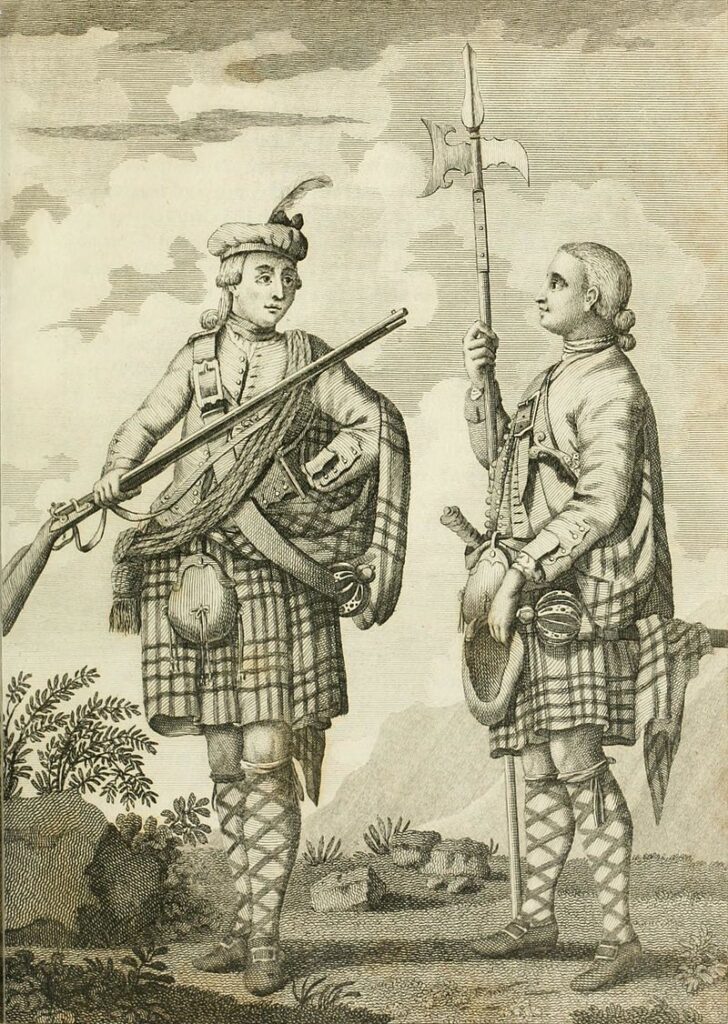
An officer and sergeant of the regiment, early in its history.
The Black Watch would enforce disarmament, pursue brigands and Jacobite operatives, and act as peacekeepers between feuding clans, just as they had been intended. In 1739, tensions with Spain would give rise to the War of Jenkin’s Ear. Taking inventory of available forces, the government decided that these disciplined, high-spirited Highlanders would be of greater use as regular soldiers than as a mere police force. The original six companies would become the core of a new regiment, formed by a Royal Warrant dated for the 25th of October, 1739, and issued to John Lindsay, 20th Earl of Crawford, who would serve as the regiment’s first Colonel.
The government almost certainly held high hopes for the Earl of Crawford’s Regiment, as the new unit was known. Throughout the preceding centuries, Highland Scots had served in the armies of France, the Netherlands, Sweden, and Denmark, among others on the continent, and had earned a reputation as fierce and disciplined soldiers. As if to give further recognition to the seemingly unique martial culture of the Highlands, the royal warrant which established the new regiment specified that recruits were to be enlisted only from among the Highland population, at a time when most regiments recruited indiscriminately from the British Isles as a whole.
This period of transition was met with apprehension from many of the Highlanders, who after ten years had grown accustomed to the Black Watch as a local constabulary and home-guard, rather than a corps of the regular army bound for service abroad. In 1742, the Regiment (now Sempill’s Regiment, with Brigadier General Lord Sempill being appointed Colonel on Christmas of 1740, the Earl of Crawford having transferred to command of the 2nd Troop of Horse Grenadier Guards) was ordered to London to be reviewed by the King for the first time. From there, they would be shipped to Flanders to join the coalition fighting France and her allies as part of the War of Austrian Succession (which had absorbed the War of Jenkin’s Ear). The regiment was indeed reviewed, and greatly impressed the court with their peculiar attire, weaponry, and language. But before they could be embarked, rumors began to sweep through the unit, that their true destination would be the Caribbean, where whole regiments of the army wasted away in an endless battle against fever. Lingering apprehensions about overseas service now gave rise to mutiny, and roughly one-hundred men attempted to march back to Scotland. Eventually intercepted, and convinced to surrender, three of the ringleaders were executed, while the remaining mutineers were distributed to other regiments. Despite this blemish, the majority of the Highland Regiment did not falter in their service, and would shortly be dispatched to the allied army forming in Flanders, where they would enter battle for the first time.
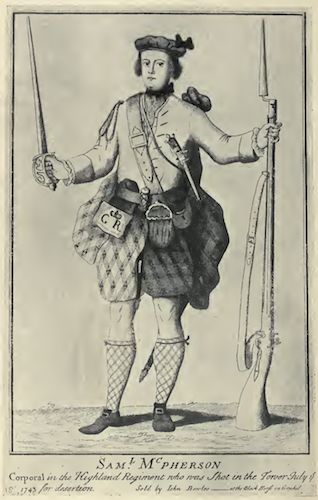
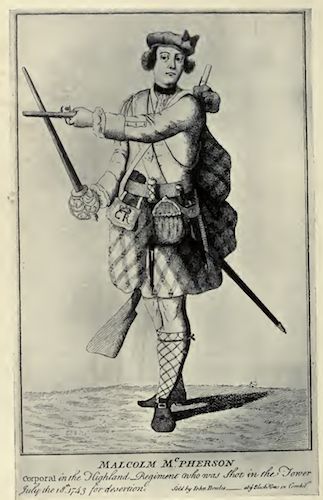
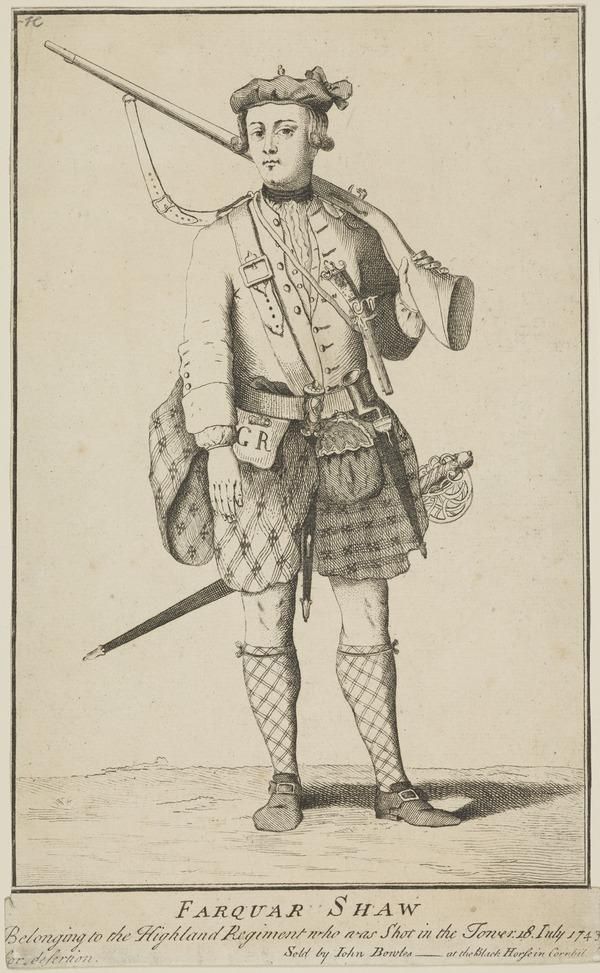
Contemporary depictions of the three mutineers executed in 1743. The remainder were acquitted, but would not return to the Highland Regiment.
Military Record – 1743 to 1775
The regiment would join the army under the personal command of the King at Hanau in late June of 1743. From there, they would spend the remainder of 1743 and all of 1744 maneuvering in a series of offensives and consolidations in which they saw no major action. During the winters of 43-44 and 44-45, the Highlanders would distinguish themselves for their honorable conduct towards the civilian populations of the winter posts. Such praise would be repeated over the decades to come, where Highland troops would be as renowned for their good conduct off the battlefield as for their ferociousness – and even brutality – while on it. It would seem that the respectability often associated with soldiering in the Highlands, as well the regional and familial connections within the regiment – reinforced by the unit’s preference for recruiting Highlanders only – served to encourage good behavior among the men while serving abroad.
The regiment’s first real combat action came near Fontenoy in modern Belgium on the 29th of April, 1745. Here, as part of the vanguard of the allied army, the Highlanders skirmished with and drove-back the French and Austrian outposts, employing the same tricks of terrain, concealment, and maneuver that been honed in the clan conflicts of their rugged homeland. The next day, on the 30th of April, the regiment would distinguish in the proper Battle of Fontenoy. When the allied army found itself forced to withdraw from the field, the Highlanders formed a part of the rearguard, and launched relentless counter-attacks to stall the Franco-Austrian forces. The regiment would employ the infamous “Highland Charge”, wherein a single volley of musketry was followed by a rush of swords, pistols, and dirks. A particular variation of this tactic was to order the men to lie prone just as an enemy volley was being prepared, remain low while it was fired, and then rush forward to put the reloading foe to flight. Lieutenant Colonel Sir Robert Munro, the regiment’s corpulent field-commander, led them with enthusiasm despite requiring assistance from others in climbing out of trenches, and remaining on his feet while under fire for fear of a struggle to rise again. Demonstrating their capabilities as shock-troops as well as skirmishers, the Highland regiment – now under Lord John Murray, who would remain their Colonel for almost forty years – left a profound impression on the senior commanders of the British Army, and expunged whatever damage the mutiny of 1743 had done to their reputation.
Between the conduct of the Highland Regiment in Europe, and the performance of Highlanders on both sides of the 1745 Jacobite Rising (including several additional companies of the Highland Regiment who saw action in the conflict), a new interest in Highland Scots took root within the British Army, and corps of Highlanders would be formed and called upon in every war to come. The potent mixture of individual initiative born from irregular warfare in a rugged and insular country, and the discipline and deference to authority derived from the traditional clan system, made for excellent soldiers. Furthermore, the ability to use the army as a kind of pressure-valve, giving Highland men an outlet for their martial inclinations that might otherwise give rise to brigandry or rebellion in the Highlands, was always an appreciated factor in the raising and recruiting of such men.
In 1751, a new series of reforms did away with the practice of referring to regiments by the names of their colonels, and numbers were assigned to all regiments of foot and horse which reflected their seniority. The Highland Regiment, then officially known as Murray’s Regiment (Or Murray’s Highlanders) became the 42nd Regiment of Foot, and would remain as such until regimental numbers were done away with in 1881.
The regiment would be called upon again in 1756 when it was dispatched to New York to assist in the North American theater of the Seven Years War. Through the Winter of 1757, the regiment was trained in light-infantry tactics, it being already understood at this point in the war that the conflict in North America would emphasize irregular warfare on the frontier. In this, the Highland troops proved most adept, and were noted as fine marksmen with a good grasp of “bushfighting”, drawing on their heritage of small conflicts back home.
In July of 1758, the 42nd would embark on an expedition under Major General Abercromby, aiming to seize the Fort Ticonderoga on Lake Champlain. Arriving at the Fort on July 8th, reports of incoming French reinforcements and the difficulty encountered in trying to establish artillery positions compelled Abercromby to attempt to immediately take the Fort by storm, hoping surprise and vigor would be enough to take the Fort without requiring a costly and risky siege. The Grenadiers would lead the assault, followed by the men of the 42nd, who are said to have hacked their way through French obstacles using their broadswords while under heavy fire, and being without ladders, are said to have climbed over each other to breech the outer works. The Fort’s defenders proved to be better-prepared and more numerous than expected, and the assault would prove a costly failure, yet the valor of the Highlanders was beyond reproach. Shortly thereafter the regiment would be awarded “Royal status”, becoming the 42nd Regiment of Foot (Royal Highland Regiment), which was unrelated to their actions at Ticonderoga, but was often erroneously believed to have been a consolation for their high casualties in the ill-conceived operation.
Around this time a second battalion of the regiment was raised, its formation being expedited when news of the first battalion’s losses reached Britain. This second battalion would initially be dispatched to the Caribbean, where it took part in the campaigns to take Martinique and Guadeloupe (where the French settlers waged an insurgent campaign against them) before being sent to New York to join the first battalion in late 1759. For the campaign of 1760, both battalions would operate in the vicinity of Lake Ontario, assisting in the seizure of Montreal and the collapse of resistance in New France. The regiment would be withdrawn to Staten Island in 1761, before being dispatched to the Carribean again in 1762, where they ended the war by seizing Havana, Cuba from the Spanish.
With hostilities winding down in early 1763, the regiment would be dispatched from Cuba to North America again to help secure Britain’s new territories. En-route to Fort Pitt (modern Pittsburgh, PA) during Pontiac’s Rebellion in July of that year, the regiment would take part in a chaotic running battle against hostile natives near Bushy Run, where the Highlanders were again distinguished for their suitability to an irregular battle, as well as their courage in meeting the enemy in close-quarters, fighting hand-to-hand. Afterwards, the regiment would be posted to Fort Pitt, from which a company-sized detachment under Captain Thomas Sterling (who would lead the regiment as Lt. Colonel during the next war) would conduct an expedition down the Ohio River and up the Mississippi to Fort Chartres in 1765. This ten-month, three thousand mile round-trip expedition would be carried out without he loss of a single man, and would earn praise from the commander-in-chief. The next year they were posted to Philidelphia, before being ordered back to the British Isles in 1767, though a number of men elected to stay in North America, either being transferred to other regiments, or accepting discharges and land-grants to settle there. From 1768 to 1775 the regiment would be stationed in Ireland, where their linguistic and cultural commonalities with the Irish populace earned them a reputation as reliable peacekeepers, though the Highlanders were still exposed to their fair share of violence and disorder in these duties.
[WORK IN PROGRESS]